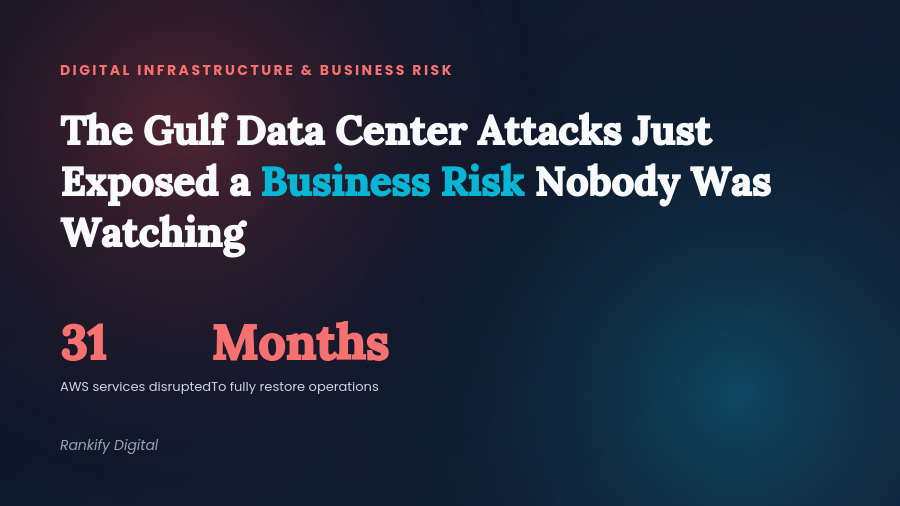
While most of the attention on the 2026 Gulf conflict has gone to oil prices, airspace closures, and troop movements, one detail has barely registered with business owners: Iranian strikes physically damaged AWS data centers in the UAE and Bahrain.
Thirty-one cloud services went down. Amazon suspended billing for affected clients and estimated it would take several months to fully restore Middle East cloud operations. Food delivery apps, online stores, booking systems, and financial services were all hit at once — not because of a software bug or a traffic spike, but because of physical damage to the servers underneath them.
WHAT ACTUALLY HAPPENED
This wasn't a distant, abstract risk. Businesses that assumed "the cloud" meant their data was somehow immune to physical events found out otherwise. A data center is still a building, in a specific location, running on physical hardware. When that location gets hit, everything hosted there goes down with it — and it doesn't come back with a simple restart.
For businesses whose entire online presence — website, ordering system, customer records — lived on that infrastructure, the outage wasn't measured in minutes or hours. It was measured in months.
THE QUESTION MOST BUSINESSES CAN'T ANSWER
Ask most business owners where their website is actually hosted, and the honest answer is "I don't know — my developer set it up." That answer was fine when the biggest risk was a slow server. It's a much bigger problem when the risk is a data center going offline for months in a region with active geopolitical instability.
The businesses that recovered fastest from this round of disruptions weren't the biggest or best-funded ones. They were the ones that happened to have backups stored somewhere else, or a hosting setup that didn't put every service in a single location. Everyone else is now finding out, after the fact, how exposed they actually were.
THIS ISN'T A ONE-TIME EVENT
It's tempting to treat this as a freak occurrence and move on. That would be a mistake. Regional instability, infrastructure attacks, and data center outages are now a recurring risk factor for any business operating in the Gulf — not a distant possibility to plan for "someday." The next disruption doesn't need to be as large as this one to take a business offline for a damaging stretch of time.
WHAT AN ACTUAL PLAN LOOKS LIKE
A real continuity plan isn't complicated, and it doesn't require an enterprise IT budget. It comes down to a handful of concrete things most businesses have simply never gotten around to:
1. Knowing exactly where your site is hosted, and whether that's a single point of failure.
2. Having backups that actually exist, that you've verified, stored somewhere other than your main server.
3. Having a way for customers to reach you and keep ordering even if your main website is down — a simple backup page, WhatsApp, or social channel.
4. Having your critical data — customer lists, product catalogs, business documents — exported and stored somewhere you personally control.
5. Having an actual written recovery plan, filled in before an emergency, not improvised during one.
None of this is complicated. All of it is the kind of thing that gets put off indefinitely — until the week it suddenly matters.
THE REAL LESSON HERE
Most businesses spend their energy worrying about traffic, rankings, and ad spend. Those things matter, but they assume the foundation underneath — the actual hosting, the actual infrastructure — will simply keep working. 2026 proved that assumption isn't safe anymore, at least not in this region. The businesses treating digital continuity as a real operational priority, rather than an afterthought, are the ones that will keep functioning next time this happens. And there will very likely be a next time.