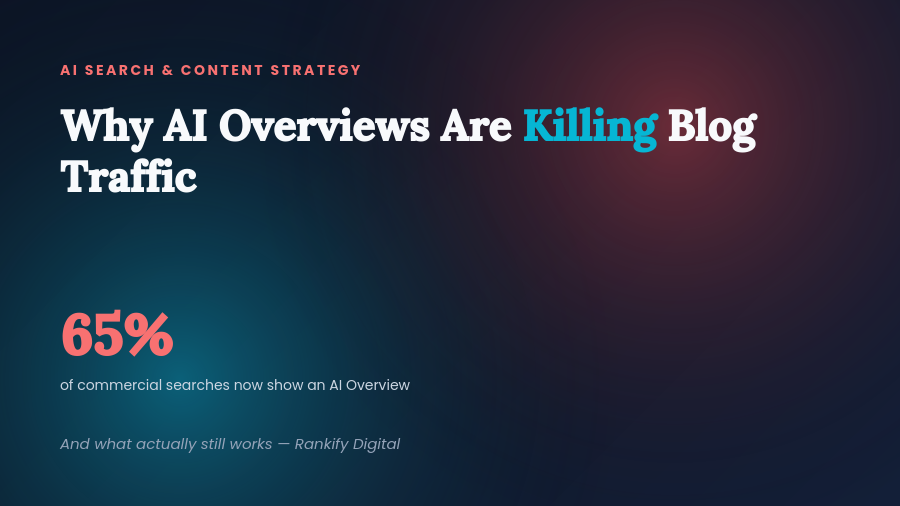
If your blog traffic has been quietly sliding for the past few months and you can't figure out why, here's the honest answer: it's probably not your writing. It's AI Overviews.
AI Overviews now appear on roughly 65% of commercial search queries. That single number explains more about falling organic traffic this year than almost any algorithm update. And the impact isn't the same everywhere — some content is getting hit hard, and some is barely moving. Knowing the difference is what separates businesses adapting well from businesses quietly losing visibility every month.
THE NUMBERS NOBODY'S TALKING ABOUT
Here's the breakdown that actually matters: informational and blog-style content is seeing organic click-through rates drop 28-34% when an AI Overview appears above it. Mid-funnel category and comparison content is down 12-19%. Meanwhile, product and service pages — the ones closest to an actual buying decision — are seeing less than a 5% change.
Read that gap carefully. AI Overviews aren't killing search traffic evenly. They're absorbing the exact layer of content most blogs are built on: "what is," "how to," "best ways to" — the explainer content that used to reliably pull in visitors.
WHY THIS IS HAPPENING
AI Overviews exist to answer a question directly, on the results page, without a click. If your blog post's entire value is a straightforward answer to a straightforward question, Google's AI can now just... give that answer itself. The click you used to get for free is gone, because the reason for clicking disappeared.
This isn't a temporary dip. It's a structural shift in what a "click" means. Publishing more generic explainer content is only going to keep feeding a problem that's already draining traffic.
WHAT'S ACTUALLY STILL WORKING
1. Original data and case studies
AI Overviews summarize existing information — they can't summarize a result you haven't published yet. Real numbers from real work (traffic changes, before/afters, specific outcomes) still pull clicks because there's no existing answer to summarize.
2. Opinion and judgment content
"What is X" gets absorbed by AI. "Should you do X, and when" often doesn't — because it requires weighing tradeoffs, not just retrieving facts.
3. Content built for AI citation, not just ranking
This is the part most blogs are missing entirely. If you can't beat AI Overviews for the click, the next best outcome is getting cited inside the AI Overview itself — appearing as the source, with your brand name attached, even without the click.
4. Product and service pages, more than ever
Since these are barely affected, this is where blog traffic that's disappearing should be redirected. Fewer generic explainer posts, more content that sits directly next to a buying decision.
HOW TO GET CITED INSTEAD OF SUMMARIZED
This is the actual skill behind adapting to this shift, and it's not complicated once you see the pattern: answer the specific question in the first two sentences, back it with a specific number or named example, then structure the rest so it's easy for an AI system to extract cleanly. Vague, padded, story-first writing gets skipped. Direct, specific, well-structured writing gets pulled into the answer — with a citation.
THE BIGGER PICTURE
Traffic isn't disappearing. It's being redistributed — toward content that offers something an AI summary genuinely can't replace, and toward businesses that show up inside the AI answer instead of losing to it. The blogs still growing right now aren't the ones publishing more. They're the ones that adjusted what "valuable content" means before their traffic graph forced the conversation.
If you want the full system for auditing and fixing this on your own site — the audit checklist, the technical fixes, and the exact content framework that gets pages cited by AI search engines — that's exactly what I built The AI Search Visibility System for.