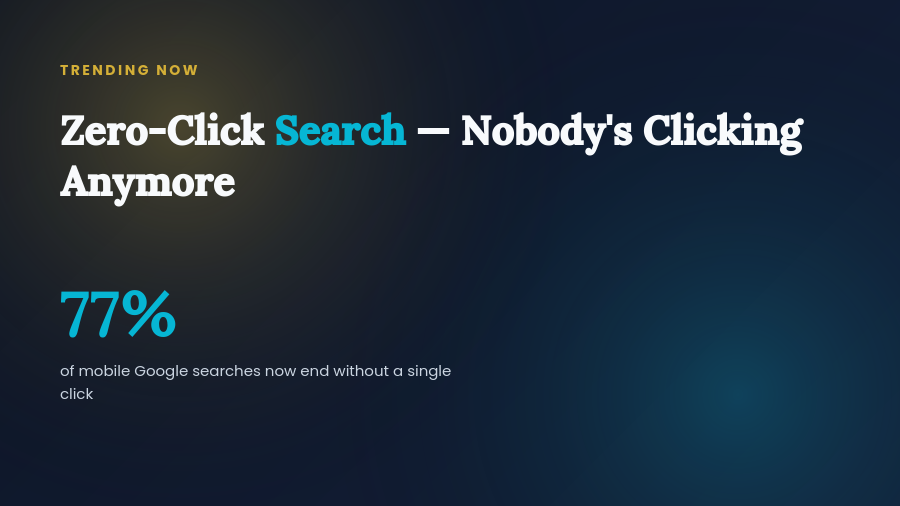
Here's a number worth sitting with: more than half of all internet searches now end without anyone visiting a website. Not a competitor's website. Not any website. The person got their answer, and they left.
That's not a fringe statistic — it's the new default behavior of the majority of search traffic. If your SEO strategy is still built entirely around "rank well, earn the click," it's built around an assumption that's already false for most of your potential audience.
WHAT ZERO-CLICK SEARCH ACTUALLY MEANS
A zero-click search happens when Google answers the query directly on the results page — through a featured snippet, a knowledge panel, or increasingly, an AI Overview — and the user never clicks through to any website at all. The answer they wanted was already sitting on the search results page.
This isn't new behavior exactly — featured snippets have caused zero-click searches for years. What's changed is the scale. AI Overviews now generate a synthesized answer for a huge range of queries, often pulling from multiple sources into one paragraph the user reads without leaving Google at all.
WHY THIS IS ACCELERATING, NOT SLOWING DOWN
Search engine market share data from early 2026 shows Google still dominant with roughly 5 billion users, but ChatGPT alone now accounts for over 17% of total digital queries — a category that essentially didn't exist in search market share data a few years ago. Industry analysts have predicted traditional search engine volume could drop by as much as 25% as more queries move to AI chat interfaces entirely, which are zero-click by design — there's no results page to click through from in the first place.
THE TEMPTING BUT WRONG CONCLUSION
The easy reaction is "SEO is dying, why bother." That's the wrong read. Search volume isn't disappearing — it's changing shape. Visibility inside the zero-click answer is still visibility. Being the source an AI Overview cites, or the site a featured snippet pulls from, still builds brand awareness and trust, even without a click that day. The businesses losing out aren't the ones getting fewer clicks — they're the ones getting cited nowhere at all.
WHAT ACTUALLY WORKS IN A ZERO-CLICK WORLD
- Answer the specific question directly, near the top. Featured snippets and AI Overviews pull concise, direct answers — buried or vague content doesn't get extracted.
- Structure content for extraction. Clear headings, short paragraphs, and FAQ schema make it easier for both Google and AI tools to lift a clean answer from your page.
- Target questions, not just topics. Zero-click answers are almost always responses to a specific question — "how much does X cost," not just "X."
- Protect what still needs a click. Pricing, booking, transactions — anything that requires an actual visit — should be the clear next step after the free answer, not hidden behind it.
- Confirm you're actually crawlable. None of this matters if AI tools can't technically read your page in the first place — a problem that's more common than most site owners realize.
CHECK WHERE YOU STAND
Before adjusting a content strategy around zero-click search, it's worth confirming the technical foundation is actually in place — structured data, crawlability, and clear answer formatting are exactly what determines whether you get cited at all. I built a free AI Search Visibility Checker that covers this in under a minute, no signup required.