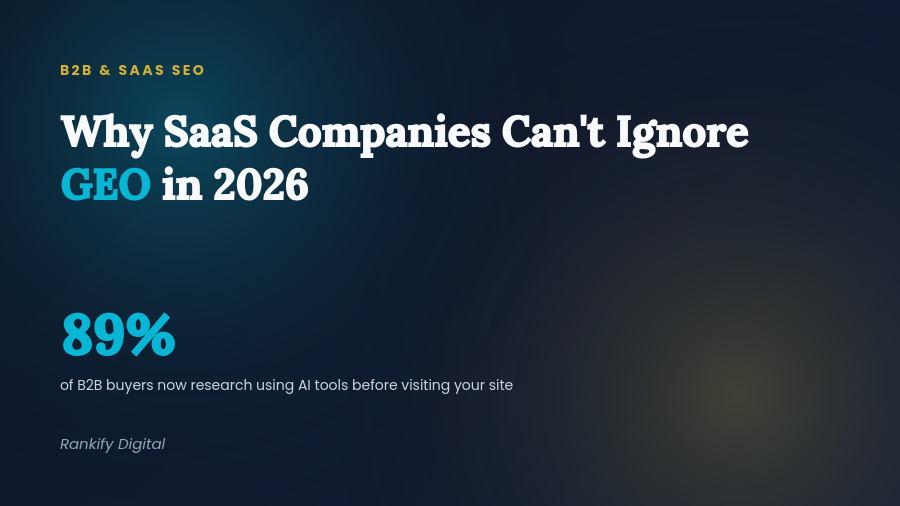
Here's the number that should worry every SaaS marketing team: 89% of B2B buyers now use generative AI platforms to research software before they ever land on a vendor's website. If your product doesn't show up in those AI-generated answers, you're not losing a little traffic — you're losing the deal before your sales team even knows it existed.
This is the same shift I've been writing about for consumer and local businesses all year — Generative Engine Optimization, or GEO — but for SaaS companies, the stakes are higher and the mechanics are different. Here's what actually matters.
WHY B2B BUYING BEHAVIOR CHANGED FASTER THAN B2C
SaaS buyers research differently than consumers. They compare features across five or six tools, read integration docs, and check pricing pages before ever talking to sales. That research process now happens largely inside ChatGPT, Perplexity, and Claude — buyers ask "what's the best [category] tool for [use case]" and act on whatever gets named in the answer. If your product isn't structured for AI to cite confidently, a competitor's is getting named instead.
WHAT MOST SAAS COMPANIES GET WRONG
The common mistake is treating GEO like traditional SEO with an AI coat of paint — publishing more blog content and hoping it ranks. AI engines don't reward volume. They reward specificity: clear feature comparisons, documented use cases with real outcomes, and content structured so an answer engine can extract a direct, confident response.
The businesses actually winning AI citations right now are doing three things differently:
- Comparison and alternative pages that fairly name competitors — AI engines cite content that reads as balanced, not promotional.
- Structured documentation and use-case libraries with specific problem-solution-outcome scenarios AI can pull directly from.
- Technical content built for retrievability — clear headings, direct answers up top, and schema markup that tells AI systems exactly what the page is about.
THE LONG-CYCLE REALITY (SET EXPECTATIONS EARLY)
Unlike a local business fixing a broken meta tag, SaaS GEO is a compounding investment, not a 30-day win. Ranking improvements on less competitive pages typically show up within three to four months. Lead volume follows around six to eight months. Pipeline impact — actual closed deals traced back to organic and AI-sourced traffic — often takes twelve months or more, simply because B2B sales cycles are long. Any SaaS founder or marketer going into this expecting overnight results is setting the team up to abandon it right before it starts working.
WHERE TO ACTUALLY START
Before building comparison pages or documentation libraries, the more urgent question is simpler: can AI tools even read your site properly right now? Many SaaS marketing sites — especially ones built on modern JavaScript frameworks — are accidentally invisible to AI crawlers before content strategy even becomes relevant. That's a technical problem, not a content problem, and it's usually the actual reason a genuinely good product isn't showing up in AI answers.
This is exactly the gap I built the AI Search Visibility Checker to catch — the same technical foundation issues apply whether it's a local business or a SaaS platform.