I was researching a business setup service recently — nothing to do with SEO, just personal research — and noticed something that had nothing to do with why I was there.
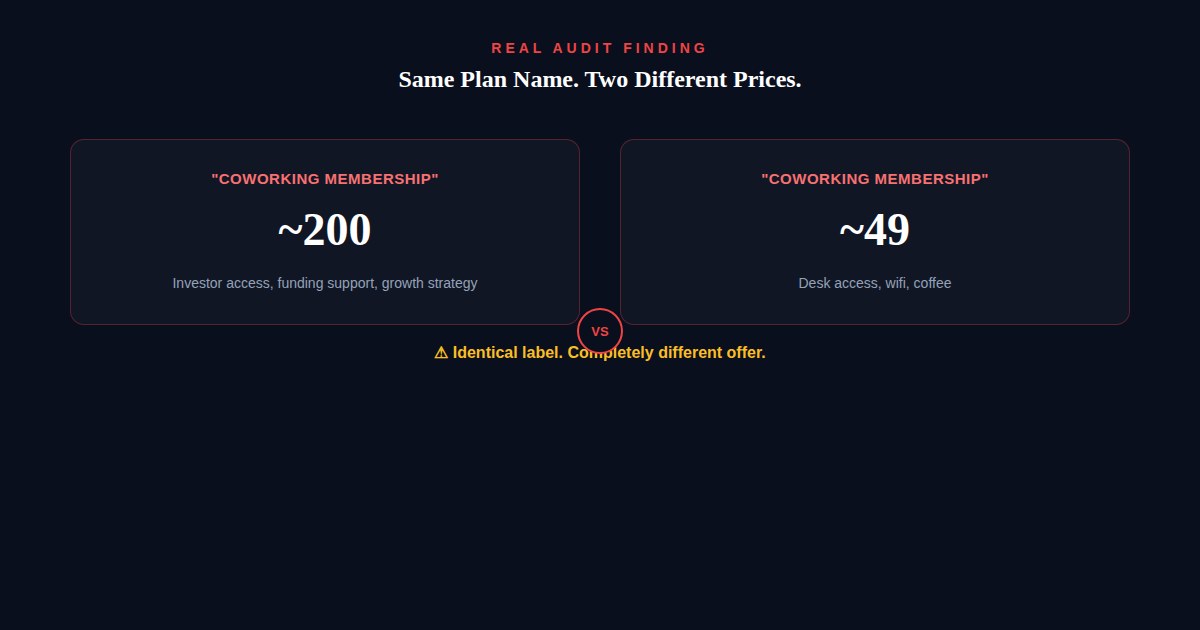
Their pricing page had two plans. Both labeled exactly the same thing. Different prices. Different features entirely.
One was priced around 200 of the local currency per month, with investor introductions, funding access, and growth strategy support listed. The other, same exact label, was priced at roughly a quarter of that, with none of those features — just basic desk access and wifi.
Two completely different offerings, wearing the same name tag.
WHY THIS HAPPENS
This isn't a rare mistake. It's actually one of the most common content bugs I find, and it usually happens the same way: a page gets built, a new tier gets added later, someone copies an existing block to save time, and the label just... doesn't get updated. Nobody catches it because nobody reads their own pricing page the way a confused customer does.
WHY IT'S MORE EXPENSIVE THAN IT LOOKS
A typo costs you nothing. A broken image costs you a little trust. A pricing mislabel costs you something much more specific: it makes a customer question whether they can trust anything else on the page.
If the pricing is unclear, is the fine print unclear too? If two plans have the same name, did the checkout process get built as carefully? That single moment of confusion doesn't just cost this one sale — it quietly undermines confidence in the entire business relationship, right at the exact moment someone was closest to becoming a customer.
WHAT I ALSO NOTICED
The same page had dozens of images either missing or not loading properly — icons, feature graphics, even part of the logo area. And the footer copyright date hadn't been updated in over a year.
None of these are individually dramatic. Together, they paint a picture of a page that hasn't been looked at critically in a while, even though the business behind it is clearly established and legitimate.
THE ACTUAL LESSON
This is exactly the kind of thing that's invisible from the inside. Whoever manages that site sees it every day and has stopped actually reading it. A new visitor — especially one comparing prices carefully, which almost everyone does — sees it once, and that's the impression that sticks.
If it's been a while since someone looked at your own pricing page as if they were a confused stranger trying to compare options, it's worth doing today. It's usually a five-minute fix once you actually notice it.