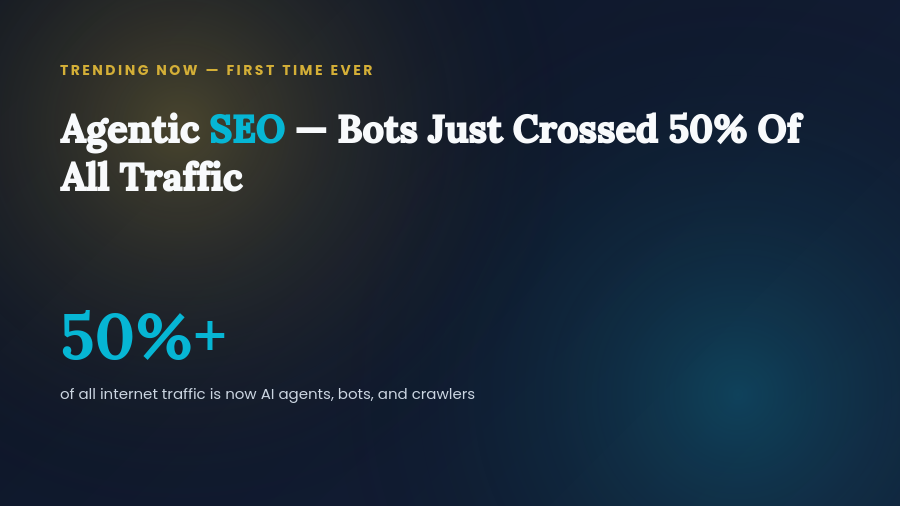
In June 2026, Cloudflare's CEO confirmed something that had never been true before in the history of the internet: bot, crawler, and AI agent traffic crossed 50% of all internet traffic. For the first time, more than half of the "visitors" hitting websites globally aren't human at all.
WHAT'S ACTUALLY DIFFERENT ABOUT THIS WAVE OF BOTS
Search engine crawlers have indexed the web for decades — that's not new. What's new is the rise of AI agents that don't just read and index, they act. A growing share of "readers" visiting a site are AI agents browsing and evaluating on a person's behalf, sometimes completing an entire purchase decision without a human reviewing every page along the way. Gartner has projected that by 2028, the majority of B2B buying could be intermediated by AI agents entirely.
WHAT AGENTIC SEO ACTUALLY MEANS
Agentic SEO is optimizing a page so an autonomous AI agent — not just a human, and not just a chatbot summarizing an answer — can reliably read, understand, and act on it. That's a distinct requirement from traditional SEO or even AEO/GEO: an agent making a purchasing decision needs clean, structured, unambiguous information it can parse programmatically, not persuasive copy aimed at a human's attention span.
THE QUIETLY TRENDING FILE: LLMS.TXT
One specific, concrete trend worth knowing about: a growing number of sites are adding a file called llms.txt at their root — conceptually similar to the long-standing robots.txt, but aimed at giving AI agents and language models a clear, structured summary of what the site actually contains.
It's a simple file, but it's an early, concrete signal of where the technical SEO conversation is heading: structured, machine-readable clarity, not just persuasive human-facing content.
PRACTICAL STEPS FOR AGENTIC SEO TODAY
- Confirm your site is actually crawlable. Agents can't act on content they can't read — heavy JavaScript rendering remains a common, invisible blocker.
- Use clean, explicit structured data. Schema.org markup gives agents unambiguous facts instead of forcing them to infer from prose.
- State prices, availability, and specs plainly. An agent comparing options needs concrete, parseable data, not marketing language wrapped around the number.
- Consider adding an llms.txt file. Still early and not universally adopted, but a low-effort way to give agents a clear summary as the practice matures.
- Keep your entity signals consistent. An agent cross-referencing your business across sources benefits from the same name and details everywhere, just like a human researcher would.
CHECK YOUR OWN TECHNICAL FOUNDATION
Most of what makes a site agent-friendly overlaps heavily with what already makes it AI-search-friendly: crawlability, structured data, and clean technical fundamentals. I built a free AI Search Visibility Checker that covers this exact ground in under a minute, no signup required.